Ultrasound – what it is, how it works, and when to use it

Introduction
Ultrasound is one of the most commonly used diagnostic methods in modern medicine. Thanks to its safety, non-invasiveness, and quick availability, ultrasound examination has become a standard in the early detection and monitoring of numerous health conditions. In addition to medicine, ultrasound is also used in industry, but in this article the focus is on its importance for patients’ health.
Below, we provide a simple and easy-to-understand explanation of what ultrasound is, how it works, what its medical applications are, and what its advantages and limitations are.
What is ultrasound?
Ultrasound is a method that uses high-frequency sound waves, above the limit of human hearing (above 20 kHz), to create an image of the body’s internal structures. These waves pass through tissues and are reflected back, and the device converts them into an image that the doctor analyzes in real time.
Unlike X-ray examinations, ultrasound does not use ionizing radiation, which makes it safe for repeated use, including for pregnant women and children.
The difference between sound and ultrasound is in the frequency – while ordinary sound is audible to the human ear, ultrasound waves enable a detailed view of organs and tissues.
How does ultrasound work?
An ultrasound examination is based on a simple yet very precise operating principle.
Generation of ultrasound waves
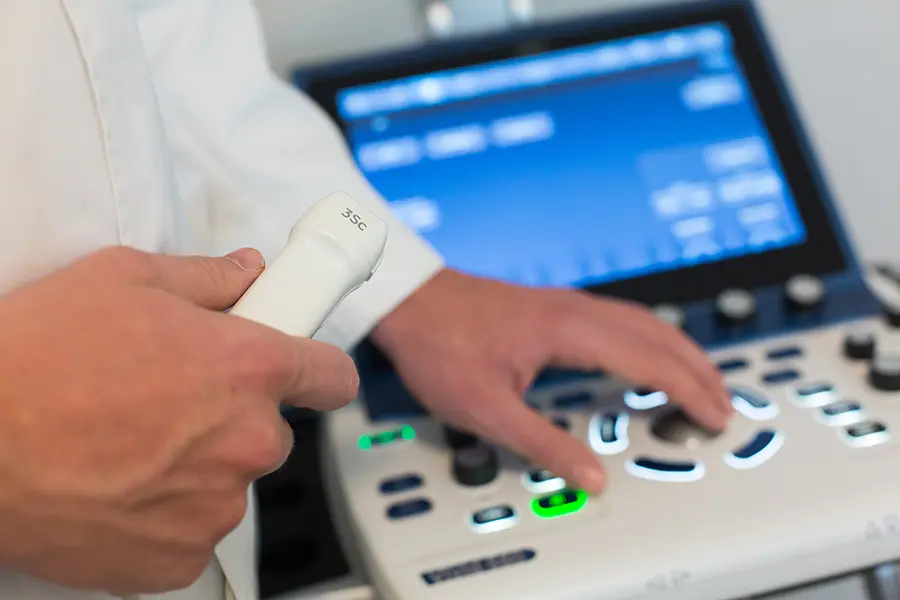
The ultrasound probe emits high-frequency sound waves that pass through the patient’s body. Before the examination, gel is applied to the skin to allow better transmission of the waves.
Reflection and signal reception
When ultrasound waves encounter different tissues and organs, part of the waves is reflected back toward the probe. Different structures reflect the waves in different ways, which makes it possible to distinguish them.
Image processing and display
The ultrasound device processes the received signals and converts them into an image displayed on the screen in real time. The doctor can immediately assess the condition of the organs and notice any changes.
Applications of ultrasound in medicine
Ultrasound has wide application in almost all branches of medicine.
Ultrasound in prenatal diagnostics
One of the best-known applications of ultrasound is pregnancy monitoring. It enables the assessment of fetal development, position, heartbeat, and the timely detection of possible abnormalities.
Diagnostic ultrasound of organs
Ultrasound is used to examine:
- the abdomen (liver, gallbladder, pancreas, kidneys)
- the thyroid gland
- the breasts
- the heart (echocardiography)
- blood vessels (Doppler ultrasound)
This method is often the first step in the diagnostic process because it provides quick and reliable information.
Therapeutic applications of ultrasound
In addition to diagnostics, ultrasound is also used for therapeutic purposes, for example in physical medicine to relieve pain and stimulate circulation.
Applications of ultrasound in industry
Although the focus of this article is medical ultrasound, it is worth mentioning that ultrasound is also used in industry, for example for:
- non-destructive material testing
- ultrasonic cleaning
- product quality control
This further confirms the reliability and versatility of this technology.
Advantages and limitations of ultrasound
Advantages of ultrasound
The main advantages of ultrasound examinations are:
- complete safety and non-invasiveness
- painlessness
- quick availability of results
- the possibility of repeating the examination without risk
For this reason, ultrasound is ideal for regular check-ups and monitoring health status.
Limitations of ultrasound
Although very useful, ultrasound also has certain limitations. Image quality may be reduced in people with higher body weight or when examining structures located deep within the body. Also, the examination result largely depends on the doctor’s experience.
Why is ultrasound an important part of prevention?
Regular ultrasound examinations enable the early detection of changes, often before symptoms appear. A timely diagnosis means faster treatment, fewer complications, and a better prognosis.
Ultrasound is often the first, but extremely important, step in preserving health.
Taking care of your health begins with a timely examination
Ultrasound is a safe, reliable, and effective diagnostic method that plays a key role in modern medicine. Whether it is a preventive examination or monitoring an existing health condition, ultrasound diagnostics provide quick and valuable information.
Book an ultrasound examination at our polyclinic and take an important step toward timely care for your health. Our expert team and modern equipment are at your disposal.
Author: Martin Drinković, MD
Excerpt from the price list:
| CD karotida | 90.00 € |
| UZV i CD karotida i VBS | 100.00 € |
| Color doppler karotida + VB sliva + transkranijski dopoler | 150.00 € |
| Color Doppler abdomena | 100.00 € |
| Color Doppler nogu (vena ili arterija) | 90.00 € |
| Color Doppler nogu (vene i arterije) | 110.00 € |
| Color Doppler ruku | 90.00 € |
| UZV abdomena | 80.00 € |
| UZV dojki | 95.00 € |
| UZV koljena | 80.00 € |
| UZV lokomotornog sustava | 80.00 € |
| UZV površinskih struktura | 75.00 € |
| UZV prostate (TRUS) | 75.00 € |
| UZV ramena | 80.00 € |
| UZV skočnog zgloba | 75.00 € |
| UZV šake | 80.00 € |
| UZV štitnjače i struktura vrata | 70.00 € |
| UZV štitnjače i uzv vođena citološka punkcija | 160.00 € |
| UZV urotrakta | 80.00 € |
| UZV penisa | 100.00 € |
| Color Doppler penilnih arterija | 150.00 € |
| UZV testisa | 75.00 € |
| UZV testisa i color dopler | 90.00 € |
| FUZIJSKA CILJANA BIOPSIJA PROSTATE | 350.00 € |
| FUZIJSKA CILJANA BIOPSIJA PROSTATE u sedaciji | 450.00 € |