Service categories
Service categories:
Media about us
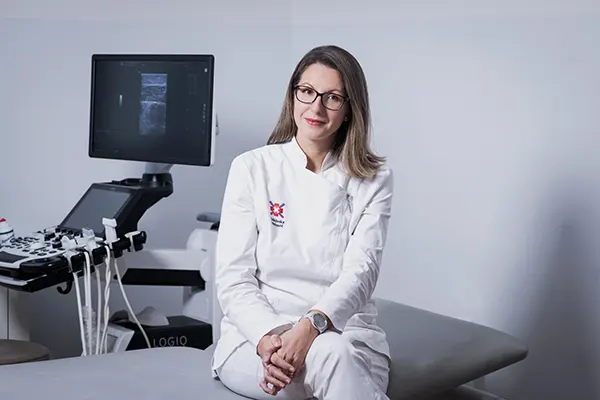

Do you know what type of breasts you have?
Radiologist Crnogorac: ‘In these two, diagnosing malignant changes can be challenging‘

Every woman should understand her unique body composition and what it means for her health. Maja Crnogorac, PhD, specialist in clinical radiology, explained what it means to have dense breasts, how this affects cancer risk, and how important different diagnostic methods such as mammography, ultrasound, and magnetic resonance imaging are.
After a mammographic examination, many women find out they have dense breasts. What does that mean?
Dense breasts, that is, breasts with dense glandular parenchyma, indicate a breast composition type in which glandular tissue predominates compared to fatty tissue. Breast structure is assessed during a mammographic examination and is classified according to the ACR BI-RADS system.
Type A includes women whose breasts are mostly fatty, which reduces the risk of diagnostic difficulties. We have type B, which includes women who have predominantly fatty breasts, but with somewhat less glandular tissue. In type C, most of the tissue is considered heterogeneous, because the glandular and fatty components are approximately equal, which can make interpretation of mammographic images more difficult. Finally, we have type D, which refers to extremely dense breasts, where glandular tissue predominates, and this significantly reduces the possibility of accurate reading of the findings.
When we talk about breast density, types C and D are particularly significant, because they can make diagnosis more difficult of potential problems. That is why it is important to monitor the dynamics of examinations and regularly consult a doctor about the most appropriate methods and frequency of examinations if you have dense breasts.
Does dense tissue increase the risk of breast cancer?
Statistics show that women with dense breasts have a somewhat higher risk of developing breast cancer, approximately 1.2 to 2 times higher risk than women with less dense breast tissue, according to most epidemiological studies. However, this does not mean that every woman with dense breasts will develop cancer, only that statistically she has a higher risk of it happening.
Is there a consensus regarding breast density and the need for additional examinations such as ultrasound and MRI?
There are guidelines for additional examinations in women with dense breasts, and decisions are made individually, depending on the risks (division of patients according to the risk of developing breast cancer, namely those with increased risk and those with average risk) and the clinical picture. Recommendations of the Croatian Society of Radiologists from 2022, which follow European guidelines, advise that women with average risk for breast cancer between the ages of 30 and 40 have an ultrasound once a year, while the first mammography with tomosynthesis is recommended at age 40. After age 40, a repeat breast ultrasound once a year is recommended as a supplement to mammography.
For women at high risk of developing cancer, such as those assessed according to the Gail model, breast magnetic resonance imaging (MRI) is additionally recommended, especially preoperatively and in cases of disproportionate radiological findings or implant problems. For women with extremely dense breasts, especially if they have a positive family history, breast MRI is advised every 3–4 years in order to ensure precise diagnosis and optimal treatment planning.
Why are dense breasts a diagnostic challenge?
During a mammographic examination, ionizing, that is, X-ray radiation is used, whereby glandular tissue absorbs X-rays more strongly than fatty tissue. On a mammographic image, therefore, fatty tissue appears black, that is, darker, while dense glandular tissue, but also tumor changes, appear white. Because of this appearance, it is difficult to distinguish healthy tissue from potentially malignant changes. In women with dense breasts, mammography may have reduced sensitivity, which is why it is necessary to perform tomosynthesis examinations (3D mammography) with supplementary ultrasound or ABUS (Automated Breast Ultrasound) if available. In Croatia, examination using the ABUS method is currently available among private polyclinics only at the Drinković Polyclinic, and among public healthcare institutions it is available at KBC Zagreb, KBC Rijeka, and the Pazin Health Center.
What affects breast density? Can breast density change?
This characteristic is influenced by various factors, including age, hormonal status, genetics, and body weight. In younger women, breasts are usually denser due to a higher proportion of glandular tissue, while with age density decreases because fatty tissue becomes dominant. Genetic predisposition also has a significant influence, so women with an inherited tendency may have dense breasts regardless of lifestyle habits.
Pregnancy, breastfeeding, and hormonal therapy can temporarily increase density, while menopause or therapy for breast cancer treatment, such as tamoxifen, reduce density in some patients due to changes in hormonal status. Breast density can also change relatively, for example due to changes in body weight.
How are fatty tissue and glandular tissue seen on a mammogram? How is a malignant change seen?
On a mammogram, fatty tissue is shown as dark gray or black, while glandular tissue appears as a white area. This can make detection of malignant changes more difficult because they too often appear as a white mass, white irregular areas, irregular masses, or tissue distortions with unclear edges. In a small number of cancers, usually those of the in situ type, microcalcifications are shown, which mammography displays excellently. It is important to note that many benign changes can also look similar, that is, white, but they are usually more regular in shape. Attempts at self-interpretation or reliance on unverified sources may lead to unnecessary concern or incorrect conclusions in patients.
My advice is that if you have a mammography finding, always consult a specialist in radiology or your doctor about it. They will interpret the finding in the context of your medical history and current health condition.
Does anything else related to the breasts affect the radiological image during examinations for breast cancer screening? For example, menstruation or breast size?
In that case, the radiological image can be influenced by various factors. Hormonal changes during the menstrual cycle affect breast density and sensitivity, which is why examinations are recommended in the first half of the cycle when the breasts are less sensitive and the tissue is less dense, which allows for better-quality images. Breast size itself does not significantly affect the quality of mammography, because imaging techniques can be adapted to ensure optimal visualization of the tissue. In patients with implants, although implants may obscure part of the tissue, special mammography techniques allow for a more appropriate display. Additionally, factors such as hormonal therapy, scars, infections, or cysts may also affect the examination and interpretation of findings.
On average, how many false-positive findings are there when we talk about radiological breast examinations?
False-positive findings depend on the type of examination. According to a JAMA Network Open study, which included 903,495 women aged 40 to 79, approximately 56.3 percent of women experienced at least one false-positive finding.
The introduction of digital breast tomosynthesis (DBT), also known as 3D mammography, has reduced the frequency of false-positive results. In breast ultrasound, 8–15 percent of findings are false positive in women with dense breast tissue. The fewest false-positive findings are obtained by combining methods – mammography and ultrasound (up to 25 percent greater sensitivity, but it increases the number of false-positive results) and mammography and MRI (this combination reduces the risk of missed malignant lesions, but increases the number of biopsies due to false-positive findings).
When is it advised to start breast examinations at the earliest?
Already from the age of 18, self-examinations should be performed once a month, ideally 7–10 days after the start of the menstrual cycle, when the breasts are least sensitive, using circular movements in a clockwise direction so that we can be sure we have covered all areas. For breast ultrasound, recommendations depend on individual factors such as age, breast density, genetic predisposition, and family history. However, in women with average risk, it is advised to start with ultrasound examinations between the ages of 25 and 30, especially in women with dense breasts. Routine ultrasound examinations in average-risk women are usually done every year. For women with a family history of breast cancer, genetic predisposition, or other risk factors, that is, in high-risk women, ultrasound examinations may begin already in the early twenties every year, and after the age of 30, breast MRI and ultrasound once a year (alternating every six months).
What are the signs that may indicate changes in the breasts?
Lumps, immobile, hard lumps or lumps that do not move in the breast or armpit, that is, any newly developed change. Also changes in the shape or size of the breast. Signs also include redness, thickening, an “orange peel” appearance, or dimpling. Regarding the nipples, discharge (especially bloody discharge), nipple inversion, and scaling. Along with all of the above, persistent pain in the breast or armpit may be felt, unrelated to the cycle, as well as enlarged lymph nodes (in the armpit or near the collarbone). If you notice any changes, contact your doctor immediately for assessment and additional tests. Early detection is key.
Excerpt from the price list:
| Ginekologija i porodništvo | |
| Klasični ginekološki pregledi | |
| Ginekološki pregled + Transvaginalni ultrazvuk (TV UZV) + Color Doppler | 90.00 € |
| Ginekološki pregled + TV UZV + Color Doppler + PAPA (standardni) | 110.00 € |
| Ginekološki pregled + TV UZV + Color Doppler + PAPA (LBC tekućinska citologija) | 130.00 € |
| Ginekološki pregled + TV UZV + Color Doppler+ HPV tipizacija | 210.00 € |
| Transvaginalni ultrazvuk (TV UZV) | 70.00 € |
| Transvaginalni ultrazvuk + Color Doppler | 80.00 € |
| PAPA razmaz + stupanj čistoće | 40.00 € |
| PAPA test - tekućinska citologija (LBC Sure Path) | 60.00 € |
| Anti-D imunoglobulin | 100.00 € |
| MR zdjelice | 250.00 € |
| MSCT abdomen sa zdjelicom s kontrastom | 300.00 € |
| Cjepljenje protiv HPV virusa | 140.00 € |
| Trudnički pregledi i ultrazvuci | |
| Test na trudnoću iz urina | 15.00 € |
| Trudnički UZV rana gestacija | 80.00 € |
| Trudnički UZV rana gestacija gemini | 100.00 € |
| Rani kombinirani probir | 150.00 € |
| Trudnički pregled, 3/4D UZV, Color Doppler u trudnoći | 120.00 € |
| Trudnički pregled, 3/4D UZV, Color Doppler u trudnoći (gemini) | 150.00 € |
| Trudnički ultrazvuk | 80.00 € |
| Mini Anomaly Scan | 110.00 € |
| Mini Anomaly Scan (blizanci) | 140.00 € |
| Mini Anomaly Scan uz NIPT testove | 100.00 € |
| Anomaly Scan | 120.00 € |
| Color Doppler u trudnoći | 50.00 € |
| Color Doppler u trudnoći + CTG | 60.00 € |
| CTG | 40.00 € |
| Uzimanje cervikalnih briseva - postupak | 35.00 € |
| Ekspertiza/drugo mišljenje u trudnoći | 150.00 € |
| Trudnice koje vode trudnoću u poliklinici | |
| Trudnički pregled, 3/4D UZV, Color Doppler u trudnoći | 100.00 € |
| Trudnički pregled stalnih pacijentica + 3/4D UZV + Color Doppler + CTG nakon 35. tj. trudnoće | 70.00 € |
| Trudnički pregled, 3/4D UZV, Color Doppler u trudnoći (blizanci) | 120.00 € |
| Mini anomaly scan | 100.00 € |
| Konzultacije | 40.00 € |
| Ginekološka ambulanta | |
| Mikrobiološke ginekološke pretrage | |
| Bris cerviksa na anaerobe + kvasnice | 40.00 € |
| Bris cerviksa na anaerobe | 30.00 € |
| Bris cerviksa na anaerobe/anaerobe/kvasnice | 50.00 € |
| Bris cerviksa na kvasnice | 30.00 € |
| Bris cerviksa - BHSB probir | 30.00 € |
| Bris cerviksa - kultura Ureaplasma i Mycoplasma | 30.00 € |
| Bris cerviksa - PCR Ureaplasma i Mycoplasma | 60.00 € |
| Bris cerviksa - PCR Clamydia trachomatis | 50.00 € |
| Bris cerviksa - PCR Mycoplasma hominis /genitalium/ | 50.00 € |
| Bris cerviksa - PCR Ureaplasma urealyticum/parvum | 50.00 € |
| Bris cerviksa - PCR panel STD prošireni | 100.00 € |
| Bris cerviksa - PCR genitalni ulkus panel | 100.00 € |
| Bris cerviksa - PCR bakterijska vaginoza panel + kvasnice | 100.00 € |
| Bris cerviksa - PCR 2 panela /anaerobi/kvasnice gratis/ | 180.00 € |
| Bris cerviksa na HPV 28 tipova HR i 14 LR | 70.00 € |
| Bris cerviksa - PCR 3 panela /anaerobi/kvasnice gratis/ | 220.00 € |
| Bris cerviksa - PCR 3 panela + HPV 28 HR /anaerobi/kvasnice gratis/ | 250.00 € |
| Urinokultura i antibiogram | 55.00 € |
| AmniSure Test- | 55.00 € |
| Anaerobi + Anaerobi | 45.00 € |
| Prenatalni testovi: | |
 |
 |
 |
 |
 |
NIFTY by Geneplanet |